


The Hybrid Founder: When Founding in Germany Means Keeping the Day Job
- Jörn Menninger
- 5 days ago
- 5 min read
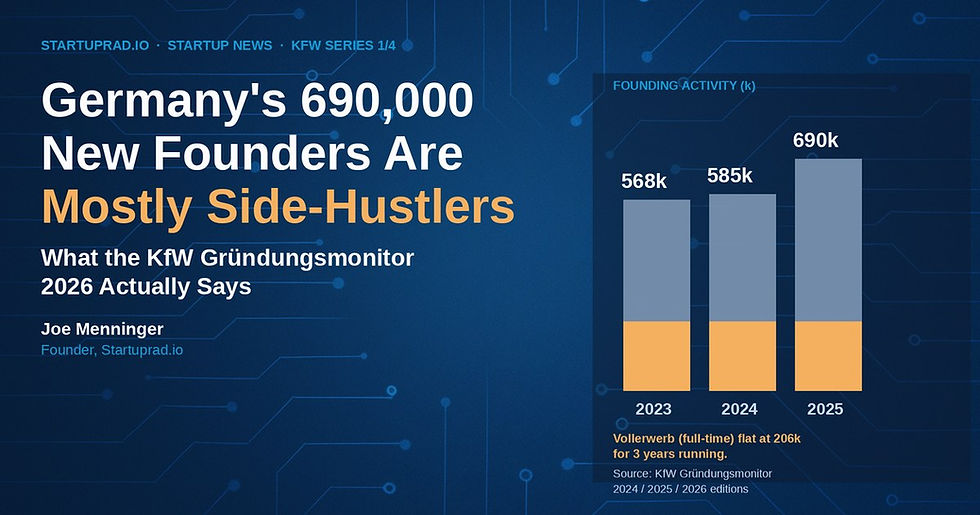
The most overlooked finding in the KfW Gründungsmonitor 2026 is not the 690,000 headline or the Nebenerwerb pivot — both covered in the cornerstone of this series. It is a measurement that has never appeared in earlier editions: 40 percent of all 2025 founders started "hybrid." They were employed before founding and remained employed after. They did not quit their job to start a business. They added one. KfW's own data now shows that the average German founder in 2025 is not a full-time entrepreneur. The German startup ecosystem has been describing a population that is not the population the data actually contains.
What Is This About?
The KfW Gründungsmonitor 2026 measures "hybrid founders" for the first time: people who keep their salaried employment while running a self-employed business. In 2025, 40 percent of all foundings were hybrid. Inside the Nebenerwerb cohort, 59 percent are hybrid; inside the Vollerwerb cohort, only 12 percent. The gap reframes who the word "founder" actually refers to inside Germany's startup economy — and reveals why the Start-up identity overclaim (25 percent self-identify, ~6 percent fit) is not a vocabulary issue but a definition issue.
What KfW Measured This Year
The 2026 edition asked two new questions of the 2025 founding cohort. First: were you employed immediately before founding? Seventy percent said yes — a record-high share in a long-running labour-market boom. Second: did you keep that employment after founding? Forty percent said yes. KfW labels these "hybride Gründungen" — hybrid foundings.
The 40 percent average hides a much sharper split. Inside the Nebenerwerb (part-time) cohort, 59 percent of starts are hybrid. The founder kept the day job and launched a side business. Inside the Vollerwerb (full-time) cohort, only 12 percent are hybrid — overwhelmingly, full-time founders leave their employment when they start. This is the cleanest operational distinction between the two cohorts KfW has ever published, and it confirms what the cornerstone of this series argued: Nebenerwerb and Vollerwerb are not two flavours of the same population. They are different populations.
The Population the Ecosystem Talks About vs the Population That Exists
When German venture capital firms describe "founders," they are describing the 12 percent hybrid share of Vollerwerb — full-time, generally non-hybrid, employee-becomes-entrepreneur trajectory. When German Mittelstand associations describe "Selbstständige," they are describing a broader set that includes the 59 percent hybrid Nebenerwerb cohort. When English-language coverage of the DACH startup ecosystem describes "the German founder," it usually means the venture-fundable subgroup that maps to roughly 6 percent of all foundings — the same number KfW found self-identify as "Start-up" and actually fit the operational definition.
The other 94 percent of 2025 founders are a different population. They are mostly part-time, mostly employed somewhere else, mostly motivated by additional income (40 percent of Nebenerwerb starts cite "higher or additional income" as the primary motive), and mostly not interested in switching to full-time entrepreneurship. KfW's long-run data shows only 20 to 30 percent of Nebenerwerb founders in any given year plan to switch to Vollerwerb within twelve months — and across the full longitudinal data, only about eight percent actually do. The realization rate is roughly one in three of stated intent.
The Hybrid-Economy Math
Forty percent of 690,000 is 276,000 — the rough count of 2025 founders who continued to draw a salary while running a self-employed business. That is more than the entire 206,000 Vollerwerb count for the same year. The hybrid cohort is now the single largest "founder" subgroup in Germany by composition. It dwarfs the Vollerwerb base. It dwarfs the founding-with-employees subgroup. The ecosystem conversation has not caught up to this.
Several practical implications follow from the math. First, employer firms are not the modal output of the founding economy — they are a small subset of it. Solo self-employment without employees was 67 percent of all 2025 foundings, and the hybrid majority sits inside that. Second, the "founder ecosystem" that talent and capital allocators care about is much smaller than the founding-activity headline suggests. The cornerstone post argued the 690,000 number is misleading; the hybrid measurement is what makes that argument operational.
Third, founder support infrastructure — accelerators, incubators, university Entrepreneurship Education programs — is mostly designed for the full-time-from-day-one population, which is a small minority of who is actually starting businesses in Germany. The mismatch between program design and founder reality is now quantifiable.
What This Means for "Founder" as a Word
The vocabulary problem is not academic. When German policymakers debate "founder" support, when investors discuss the "founder" pipeline, and when Startuprad.io covers the DACH ecosystem for English-speaking audiences, the word is doing a lot of definitional work without anyone agreeing on which population it covers. KfW's 2026 measurement makes the looseness expensive. If "founder" means the hybrid majority, then 690,000 in 2025 is accurate but tells you almost nothing about Germany's startup pipeline. If "founder" means the operational-Start-up subgroup, then the number is closer to 40,000–45,000, and the year-over-year change is essentially flat against a labour-market backdrop that should have produced more.
The cleanest fix is to use both numbers when describing the ecosystem. The KfW headline captures founding activity in the broad statistical sense — useful for policy debates about Mittelstand succession, regional labour markets, and Bildungspolitik. The Vollerwerb-with-employees-and-Start-up-characteristics subgroup captures founding activity in the operational sense — useful for venture pipeline, employment effects, and the international comparability that the ecosystem usually wants when benchmarking against France, the UK, or the US.
The Hybrid Cohort Is a Story About Risk Tolerance
There is one more reading of the hybrid finding that ties back to the longitudinal piece earlier in this series. Three years of KfW data have shown that the most powerful abandonment driver in the German founding process is fear of social descent if the venture fails (Risk Ratio 1.5×). The hybrid model is the operational response to that fear: founders who refuse to abandon the day job's social safety net. The structural rise in hybrid starts is, in part, what financial-risk and social-descent aversion looks like when founders solve for it themselves. Germany's founding economy is not absent — it is shaped, all the way down, by the cost of failure.
The final post in this series examines the generational dimension of the same risk-tolerance question: whether the under-30 founder share is a real generational shift or an artefact of the student stage of life, where the cost of failure is structurally lower. Catch it next Thursday.
Joe Menninger is the founder of Startuprad.io, an English-language editorial intelligence platform covering the DACH (Germany / Austria / Switzerland) startup ecosystem. This is the third of a four-part series on the KfW Gründungsmonitor 2024–2026 editions.
Entity Relationships
Core finding
The KfW Gründungsmonitor 2026 introduces "hybrid founder" measurement: 40% of 2025 founders were employed before founding and remained employed after.
Cohort split
Inside Nebenerwerb: 59% hybrid. Inside Vollerwerb: 12% hybrid.
Quantification
40% of 690,000 = ~276,000 hybrid founders in 2025 — larger than the entire 206,000 Vollerwerb cohort.
Realization gap
20–30% of Nebenerwerb founders plan to switch to Vollerwerb within 12 months; ~8% actually do.
Risk tolerance link
Three-year KfW data shows fear of social descent (1.5× Risk Ratio) is a major abandonment driver. Hybrid founding is the operational response.


Comments